
The retail landscape is undergoing a seismic shift. If the last decade was defined by the transition to mobile commerce, the next will be defined by Generative AI.
What started as a buzzword with the launch of ChatGPT has rapidly matured into critical infrastructure for modern e-commerce. Retailers are no longer asking if they should use AI, but how fast they can deploy it to gain a competitive edge.
According to recent industry reports, early adopters of AI in retail are projected to have a lead of more than two years over their competitors. But what does this look like in practice? It goes far beyond simple chatbots.
Here are the top use cases for Generative AI that are reshaping retail in 2025.
1. The Next Generation of Virtual Try-On
For fashion retailers, the "confidence gap" has always been the biggest hurdle to online sales. Will this fit me? Will it look good on my body type?
Traditional AR (Augmented Reality) tried to solve this with 3D overlays, but often looked cartoonish or required expensive 3D modeling. Generative AI has changed the game.
Tools like Genlook use generative models to realistically "dress" a customer's photo. The AI understands fabric drape, lighting, and body shape, creating a photo-realistic image that shows exactly how the garment will look.
- The Impact: This isn't just a fun feature; it's a financial one. Retailers using Generative AI for try-ons report significantly lower return rates and higher conversion rates by eliminating "bracketing" (purchasing two sizes to return one).
2. Hyper-Personalized "Agentic" Shopping Assistants
We are moving beyond "Customers who bought this also bought..." toward true Agentic Commerce.
In 2025, Generative AI enables "Smart Shopping Agents" that understand natural language, context, and intent.
- Example: Instead of filtering by "Red Dress" and "Size M," a shopper can ask: "I need an outfit for a summer wedding in Santorini that costs under $200 and matches my gold sandals."
- The Agent's Response: The assistant doesn't just list products; it curates a lookbook, suggesting breathable fabrics for the Greek heat and styles appropriate for a wedding guest, explaining why it made those choices.
Brands like Zalando and Carrefour have already deployed versions of this, using Large Language Models (LLMs) to guide customers through massive inventories with the expertise of a personal stylist.
3. Dynamic Product Content & "AI Studios"
One of the most time-consuming tasks for e-commerce managers is content creation. Writing unique, SEO-friendly descriptions for thousands of SKUs and shooting professional photos is a logistical nightmare.
Generative AI solves this on two fronts:
- Text: AI can generate unique, brand-voice aligned product descriptions in seconds, optimized for specific keywords.
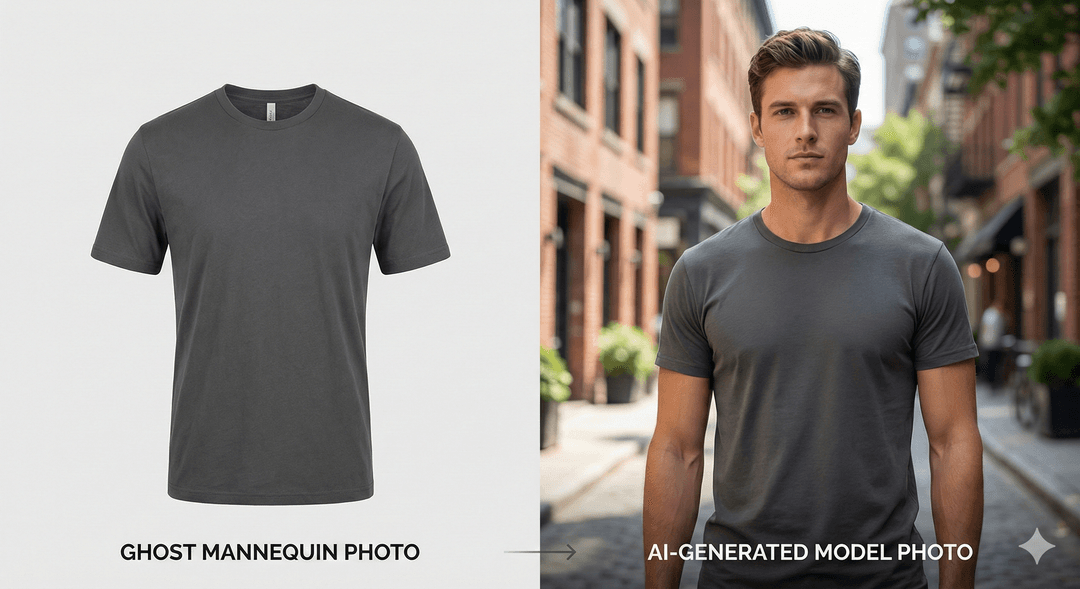
- Images (The "AI Studio"): Tools now allow merchants to generate professional product imagery without a photoshoot. By taking a simple ghost-mannequin photo of a shirt, AI can generate images of that shirt worn by diverse models in various settings (e.g., a beach, a city street, a studio). This allows for Dynamic Content where a user might see a model that resembles them, increasing relatability.
4. Visual Search & Generative Discovery
Text search is limiting. Sometimes you can't describe what you're looking for, but you know it when you see it.
Generative AI enhances visual search capabilities, allowing users to upload a photo of an outfit they saw on TikTok or Instagram and find the closest matching items in your store. It bridges the gap between inspiration and purchase instantly.
Furthermore, Generative Discovery creates new interfaces. If a user lingers on minimalist furniture, the website's homepage can autonomously "re-skin" itself to highlight minimalist aesthetics, hiding the rustic or industrial collections.
5. Smarter Demand Forecasting & Supply Chain Twins
While less visible to the customer, this is perhaps the most impactful use case for a retailer's bottom line.
Generative AI models create "Digital Twins" of the supply chain. They analyze vast datasets—historical sales, social media trends, weather patterns, and economic indicators—to predict demand with frightening accuracy.
- Benefit: This helps retailers optimize inventory levels, reducing the twin risks of stockouts (missed revenue) and overstock (waste and markdowns). For sustainable fashion brands, producing only what is needed is the ultimate green strategy.
6. Fraud Detection and Risk Management
As transaction volumes grow, so does sophisticated fraud. Generative AI is a double-edged sword here; while it can be used by bad actors, it is also a powerful shield for retailers.
AI systems can analyze transaction patterns in real-time to detect anomalies that human rules might miss. They can distinguish between a legitimate high-value purchase and a fraudulent account takeover, reducing chargebacks without adding friction for real customers.
Conclusion: The Early Adopter Advantage
The integration of Generative AI in retail is not just about automation; it's about augmentation. It augments the customer's ability to visualize products (via Virtual Try-On), the merchant's ability to create content (via AI Studios), and the buyer's ability to find exactly what they need (via AI Assistants).
In 2025, the technology is accessible. Apps like Genlook bring enterprise-level Generative AI to Shopify merchants of all sizes. The question is no longer whether to adopt AI, but how quickly you can integrate it to deliver the personalized, seamless experiences that modern shoppers demand.
FAQ
Frequently Asked Questions
How is Generative AI different from traditional AI in retail?↓
Traditional AI analyzes data to make predictions (like recommending products). Generative AI creates new content—text, images, or code. In retail, this means generating product descriptions, realistic virtual try-on images, or personalized marketing emails.
Can Generative AI reduce return rates?↓
Yes, significantly. By powering advanced Virtual Try-On tools (like Genlook), Generative AI allows customers to see how clothes fit on their actual body type, leading to more informed purchases and fewer size-related returns.
Is Generative AI expensive to implement for small stores?↓
Not anymore. While enterprise solutions exist, many Shopify apps now democratize this technology. Tools for AI product photography, description writing, and virtual try-on are available as affordable subscriptions for merchants of all sizes.
What is 'Hyper-personalization'?↓
Hyper-personalization uses AI to tailor the shopping experience in real-time. Instead of generic segments, it treats every visitor as unique, adjusting search results, product recommendations, and even website layout based on their immediate behavior.