
 Shopify
 WooCommerce
It is the silent profit-killer of the digital age.
In 2024 alone, U.S. shoppers returned an estimated $890 billion in merchandise. That is not just a logistics headache; it is a financial hemorrhage. For fashion retailers on Shopify, the numbers are even starker: while the average e-commerce return rate hovers around 17%, the apparel sector often sees rates climb between 20% and 30%.
As we settle into late 2025, the "returnpocalypse" shows no signs of slowing down. The rise of "bracketing", where customers buy multiple sizes of the same item with the intent to return all but one, has normalized a behavior that drains margins and creates immense environmental waste.
But here is the good news: Returns are not an inevitable cost of doing business. They are a solvable data and experience problem.
This is your 2025 Playbook for slashing return rates, protecting your bottom line, and turning the "fitting room gap" into a competitive advantage.
Part 1: Diagnosing the Crisis (The Numbers)
Before we fix it, we have to respect the scale of the problem. According to recent industry reports from the NRF and consumer behavior analytics, the landscape has shifted dramatically.
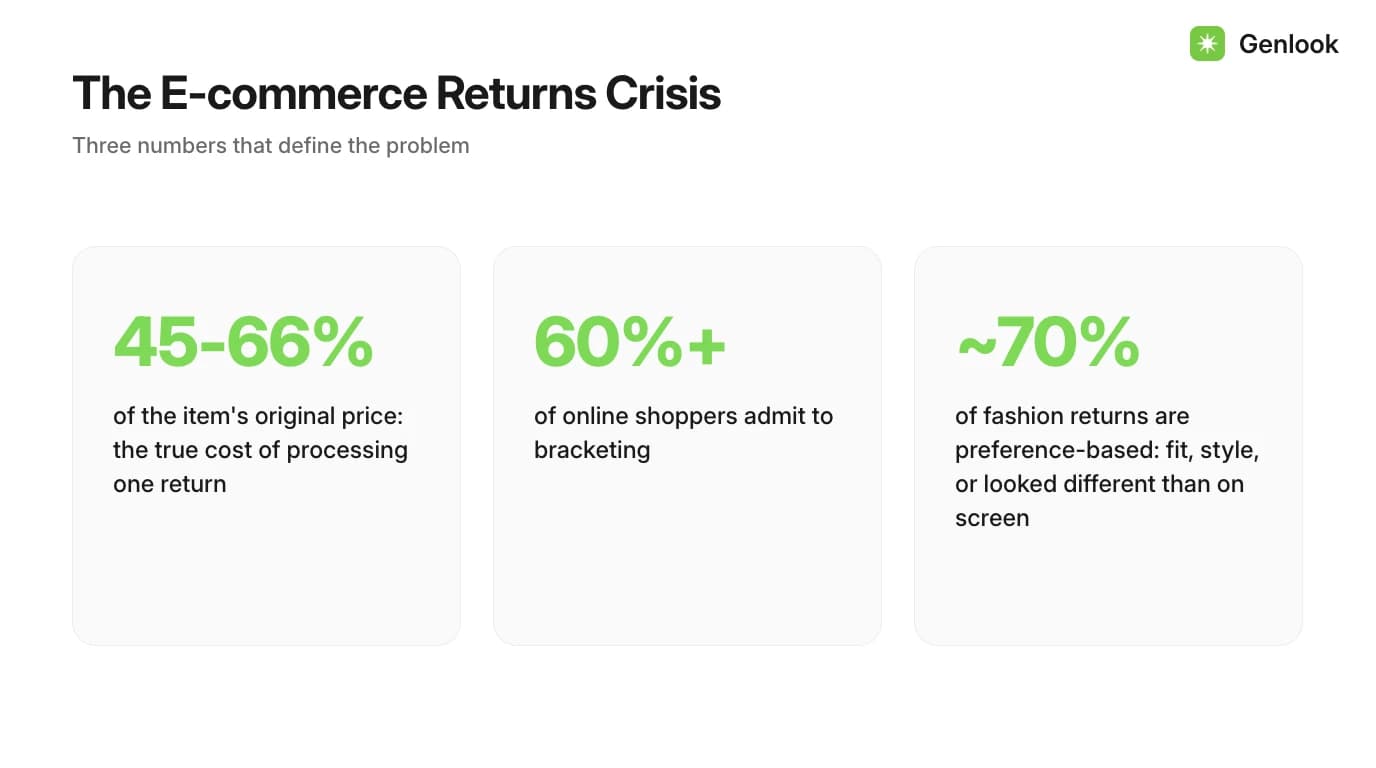
The True Cost of "Free Returns"
Many merchants make the mistake of looking only at the refunded revenue. The reality is much more expensive. When you factor in shipping (both ways), warehousing, inspection, restocking, and potential liquidation, processing a return can cost a retailer 45% to 66% of the item's original price.
If you sell a dress for $100 and it gets returned, you haven't just lost the $100 sale; you have likely spent $50 handling the failure.
The "Bracketing" Boom
Over 60% of online shoppers now admit to bracketing. It is not malicious; it is a coping mechanism. Shoppers know that a "Medium" in one store is a "Large" in another. Without a physical fitting room, they use their credit card to buy certainty.
The Trust Gap
The vast majority of returns (approx. 70%) in fashion are due to "preference-based" reasons:
- Poor fit.
- Style mismatch.
- The item looked different in person than on the screen.
In 2025, if you are relying on a static size chart and a generic 30-day return policy to manage this, you are fighting a modern war with ancient tools.
Part 2: The Core Causes
Why do customers really send things back?
1. The "Fit & Feel" Disconnect (50% of Returns)
The number one culprit remains fit. Sizing varies wildly between brands. Vanity sizing has muddied the waters. Without the ability to try an item on, the customer is guessing. When they guess wrong, you pay the shipping.
2. The "Expectation vs. Reality" Gap (22% of Returns)
"It looked different on the model." Studio lighting, professional pinning, and retouching can make a garment look drastically different than it does on a real body in a real room. When the physical product fails to match the digital promise, trust is broken, and the return label is printed.
3. Impulse & Remorse
With one-click checkouts and "Buy Now, Pay Later" schemes, the friction to purchase is lower than ever. This leads to impulse buys that look less appealing once the package arrives.
Part 3: The 2025 Playbook (5 Strategies to Cut Returns)
Reducing returns requires a multi-pronged approach that targets the psychology of the shopper before they hit the buy button.
Strategy #1: The Visual Revolution (Virtual Try-On)
This is the single most effective lever available to Shopify merchants in 2025.
The Logic: If half of your returns are due to fit and style uncertainty, the solution is to remove the uncertainty. Virtual Try-On (VTO) technology allows customers to visualize the product on their own body, not a model's.
The Data: Retailers implementing robust VTO solutions have seen return rate reductions of 20% to 30%. Furthermore, conversion rates on pages with VTO often jump by 200%.
The Execution: Tools like GenLook have democratized this technology. You no longer need a six-figure custom development budget. By integrating an AI-powered widget that lets users upload a photo and see the garment on themselves, you bridge the physical-digital gap instantly.
- Stop Bracketing: When a customer can see that the "oversized" look is too big for their frame, they don't buy the Large "just in case." They buy the Medium with confidence.
- Increase Ownership: Psychologically, seeing an item on one's own body creates a sense of ownership before the purchase is even made, reducing "buyer's remorse."
Strategy #2: Intelligent Sizing (Beyond the Chart)
Static size charts are often ignored or misunderstood. In 2025, "Intelligent Sizing" is the standard.
- Contextual Sizing: Instead of just measurements, use comparisons. "If you wear a size 10 in Nike, order a size 8 here."
- Review-Based Feedback: Displaying aggregate data from reviews (e.g., "85% of buyers say this runs true to size") gives shoppers the social proof they need to pick the right size the first time.
Strategy #3: High-Fidelity PDPs (Product Detail Pages)
The "Expectation Gap" closes when you provide more visual data.
- 360-Degree Views: Let the customer spin the product.
- Video: A 10-second clip of the garment in motion shows fabric drape and stiffness that photos cannot convey.
- UGC (User Generated Content): Show the dress on real customers of different shapes and sizes in your review section. This "unpolished" reality helps manage expectations better than a perfect studio shot.
Strategy #4: Frictionless Exchanges Over Refunds
You will never eliminate returns entirely, but you can save the revenue.
- The Strategy: Make exchanges one click easier than refunds. If a customer wants to return for a size issue, offer an instant exchange with zero shipping fees.
- Incentivize Store Credit: Offer a 10% bonus if they choose store credit over a cash refund. This keeps the money in your ecosystem.
Strategy #5: Post-Purchase Communication
Sometimes, a return happens because the customer doesn't know how to use or wear the product.
- Educational Flows: If you sell complex items (like technical gear) or high-maintenance fabrics (like silk), send an automated email upon delivery with care instructions or styling tips.
- The "Check-In": A simple email asking "How's the fit?" 3 days after delivery can catch issues early. If they are unhappy, you can guide them to an exchange before they get frustrated and demand a refund.
Part 4: Why GenLook is the Merchant's Secret Weapon
Implementing VTO used to be complicated, requiring 3D rendering assets and heavy code. GenLook changes that for Shopify merchants.
1. Zero-Friction Integration: GenLook is designed for the Shopify ecosystem. It installs as a widget on your product page. You don't need 3D models of your clothes; the AI works with your existing product photos.
2. Personalization at Scale: Shoppers upload their own photos. This is critical. Seeing a dress on a similar-looking model is helpful; seeing it on yourself is transformative. It creates an emotional connection that static images cannot match.
3. Lead Capture Engine: GenLook isn't just a return-reducer; it's a list-builder. The app allows you to capture emails during the try-on process, meaning you are gathering high-intent leads who are actively visualizing your products.
4. Analytics that Matter: Understand which items are being "tried on" the most and how that correlates with purchases. This data can help you identify popular items that might have underlying fit issues if the conversion rate doesn't match the try-on rate.
Conclusion: The Path to Profitability
In the high-volume world of 2025 e-commerce, retention is the new growth.
Every return you prevent is money that stays in your bank account. It is carbon that isn't emitted into the atmosphere. It is a customer relationship that remains intact.
By combining the psychological power of Virtual Try-On with smarter sizing and clearer communication, you can stop the bleeding. The technology is here. The customers are waiting.
Ready to drop your return rate? Install GenLook: AI Virtual Try On on Shopify today.
FAQ
Questions, answered.
What is "bracketing" in e-commerce?↓
Bracketing is a shopping behavior where a customer buys multiple versions of the same item (usually different sizes or colors) with the intent to try them all on at home and return the ones that don't fit. It currently accounts for nearly 40% of all online returns.
What is the average return rate for fashion e-commerce in 2025?↓
While general e-commerce return rates sit around 17%, the fashion and apparel sector sees significantly higher rates, often fluctuating between 20% and 30% due to sizing inconsistencies.
How does Virtual Try-On (VTO) reduce returns?↓
VTO tools like Genlook address the root cause of returns: uncertainty. By allowing customers to visualize the item on their own body, fit confidence increases. Data shows VTO can reduce return rates by 20% to 30% while simultaneously boosting conversion.
Does lengthening the return window actually help?↓
Yes. It triggers the psychological "endowment effect." Short windows (e.g., 14 days) create panic and urgency to return. Longer windows (e.g., 60 days) allow the customer to bond with the product, often leading to them keeping it.