
 Shopify
 WooCommerce
ASOS Joins the Try-On Race, With a Twist
In February 2026, ASOS quietly shipped one of the smartest virtual try-on implementations we have seen from a major retailer. Built in partnership with AIUTA, the feature gives shoppers two ways to see how a garment looks before buying:
- On themselves: upload a photo and let generative AI render the garment on your own body.
- On a model that looks like them: pick from a roster of 20 diverse AI models spanning different body shapes, sizes, and skin tones.
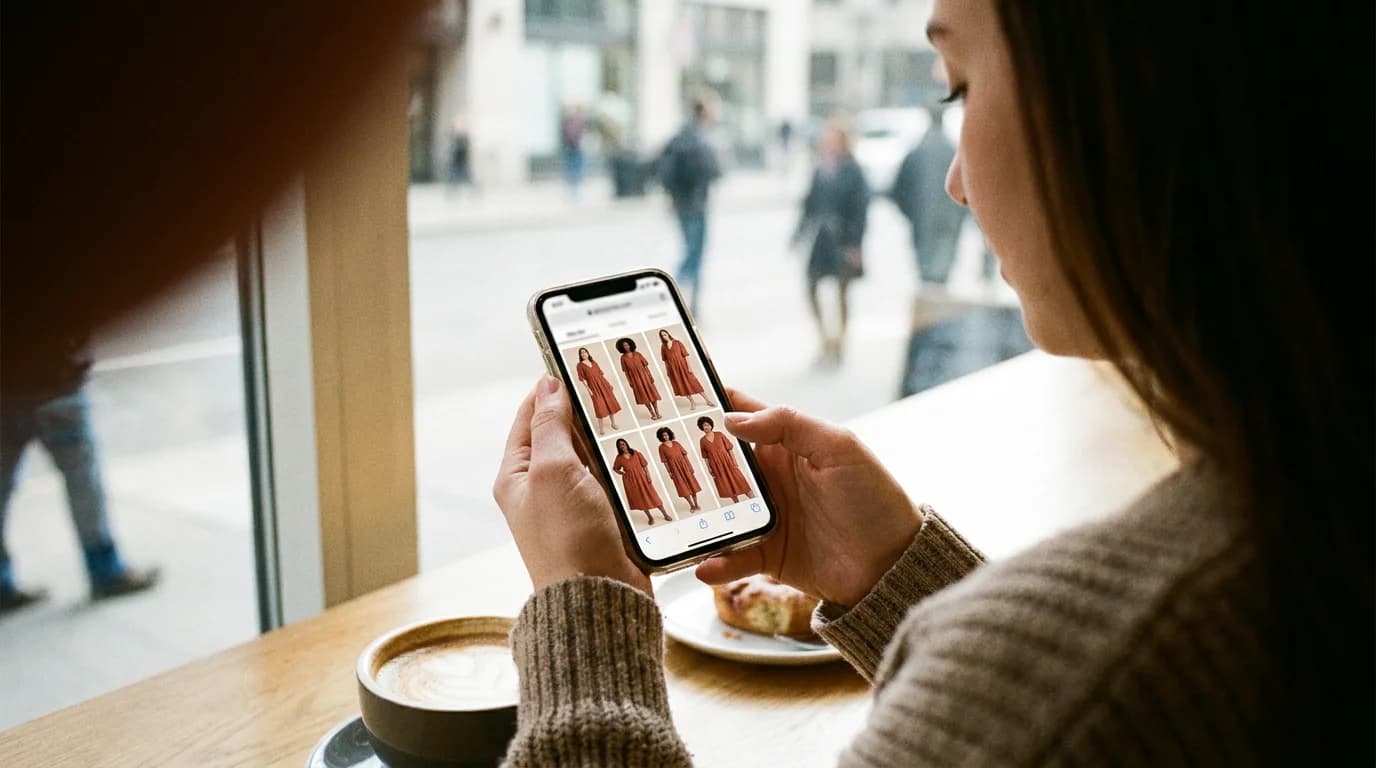
ASOS calls it a "hybrid approach", and the framing matters. Where Zara bet everything on a high-fidelity 3D avatar locked inside its app, ASOS is meeting shoppers where they actually are: some people love uploading a selfie, and some people never will.
Here is why this launch deserves more attention than it got, and what independent merchants should copy from it.
Why "Hybrid" Is the Right Call
Every virtual try-on rollout runs into the same wall: a meaningful share of shoppers hesitate to upload a photo of themselves. Privacy concerns, self-consciousness, or simply being on a train: the reasons vary, but the drop-off is real.
Most retailers pick one side of the trade-off:
- Selfie-only try-on (like Zara's avatar) delivers maximum personal relevance but excludes the photo-shy.
- Model-only visualization (the classic "view on model" toggle) is frictionless but generic: a size-8 sample model tells a size-20 shopper very little.
ASOS refused to choose. The 20-model roster acts as a zero-friction on-ramp: a shopper who would never upload a selfie can still see the dress on a body that resembles theirs. And once the feature proves its value, upgrading to "try it on me" is a much smaller psychological step.
The Inclusivity Angle Is Not Marketing Fluff
The diverse model roster solves a genuine merchandising problem. Sample-size photography systematically under-serves the majority of shoppers, and fit uncertainty is the top driver of fashion returns. Letting a shopper pick a model with their body shape is a returns-reduction feature dressed up as an inclusivity feature. It is both.
What Independent Merchants Should Take From This
You do not need an ASOS-sized engineering team to apply the lesson. The playbook breaks down into three principles:
- Lower the barrier to the first try-on. Every extra step (app download, avatar creation, multi-photo onboarding) bleeds users. ASOS's model roster is the "try before you commit" tier.
- Represent real bodies. If your product photography only shows one body type, virtual try-on is your cheapest path to showing the garment on many.
- Keep it on your product page. ASOS runs this natively in its own funnel, not inside a third-party app or a search engine. The conversion happens where the "Add to cart" button is.
Doing This on Your Own Store
Genlook brings the same core experience to your store, whether you run on Shopify, WooCommerce, or another supported platform:
- One-photo try-on: shoppers upload a single photo (a mirror selfie works) and see the garment rendered on themselves in seconds, with no app, no 3D avatar, no multi-minute wait.
- Works with your existing photography: no 3D assets or reshoots required.
- Native to your product page: the entire experience lives on your domain, feeding your conversion rate instead of a platform's.
The 2026 Try-On Landscape So Far
ASOS's launch slots into a year where every major player has made a move:
| Zara | Google Search & Shopping | ASOS × AIUTA | Genlook (Store Native) | |
|---|---|---|---|---|
| Where it happens | Zara app only | Google search results | asos.com & app | Your own product page |
| Photo required? | Two photos + 3D avatar | Optional (selfie or models) | Optional: photo or 20 AI models | One photo |
| Wait time | ~2 minutes (avatar build) | Seconds | Seconds | Seconds |
| Inclusive model roster | No | Partial | ✅ 20 diverse models | Uses the shopper's own photo |
| Available to your store | No | Only via Google's funnel | No | ✅ Shopify, WooCommerce & more |
The pattern across Zara, Google, and now ASOS is unmistakable: generative AI try-on is becoming a standard shopper expectation, and each giant is building it inside its own walled garden.
The Bottom Line
ASOS just validated the most pragmatic version of virtual try-on: give shoppers a choice between their photo and a body that looks like theirs, and remove every excuse not to click "try it on".
The giants are training your customers to expect this. The good news: unlike Zara's avatar pipeline or ASOS's AIUTA partnership, this technology is available to independent merchants today.
Get started with Genlook and give your shoppers the try-on experience the big players are making standard: on Shopify, WooCommerce, and every platform we support.
FAQ
Questions, answered.
What is ASOS's hybrid virtual try-on?↓
Launched in February 2026 with AI partner AIUTA, ASOS's feature lets shoppers visualize garments either on their own uploaded photo or on one of 20 diverse AI models covering a range of body shapes, sizes, and skin tones.
Why does ASOS offer AI models instead of only selfie try-on?↓
Not every shopper is comfortable uploading a personal photo. The AI model roster gives privacy-conscious shoppers a frictionless way to see garments on a body similar to theirs, while selfie upload remains available for maximum personalization.
Can independent online stores offer an ASOS-style virtual try-on?↓
Yes. Genlook adds generative AI try-on directly to product pages on Shopify, WooCommerce, and other supported platforms: shoppers upload a single photo and see the garment on themselves in seconds, with no app download or 3D modeling required.