 Shopify
 WooCommerce
 API
APIDrape
The way a fabric hangs, folds, and flows when worn on a body.
What is drape?
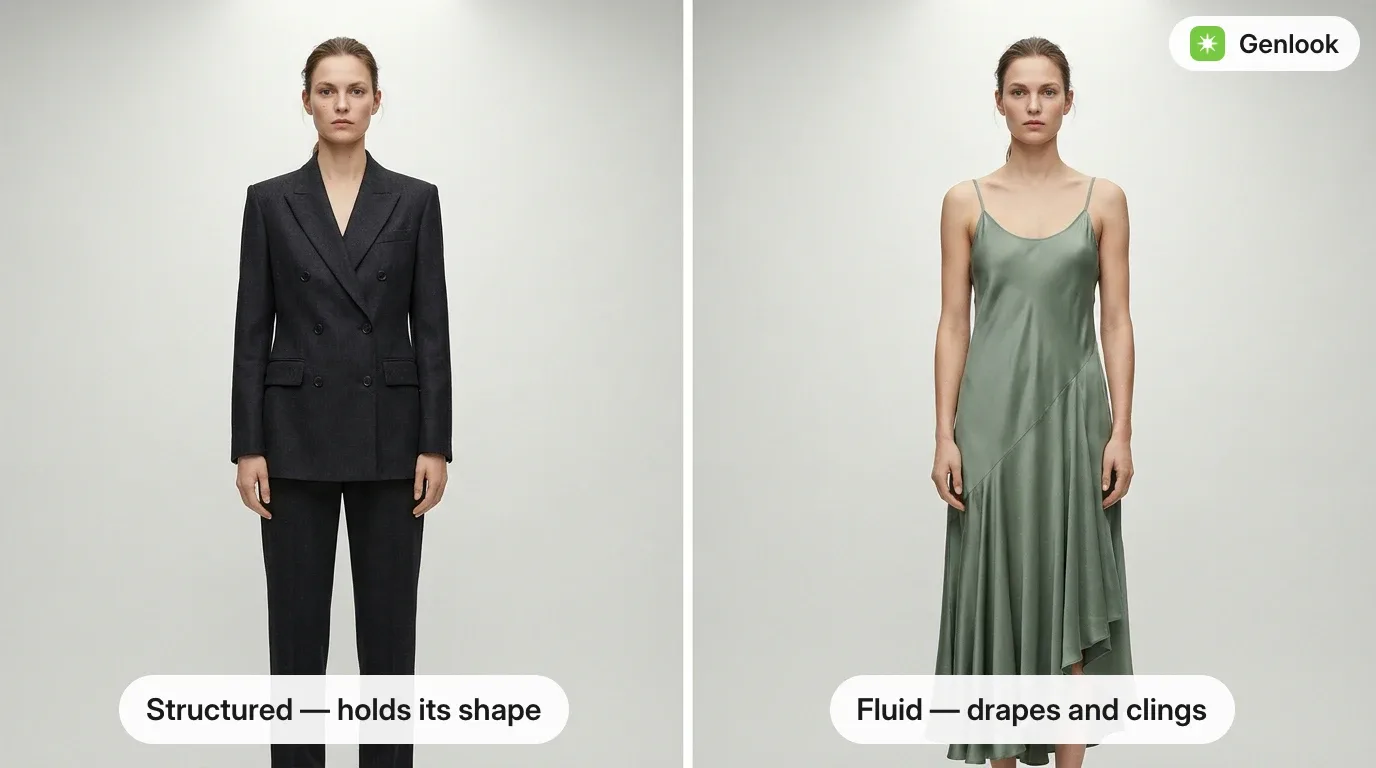
Drape refers to the way a fabric hangs, folds, and flows when worn on the body. A stiff denim falls in straight lines and holds its shape; a silk charmeuse clings and cascades into many small folds. The same dress pattern produces visibly different silhouettes depending on the fabric's drape.
Drape is determined by the fabric's weight, stiffness, weave, and fiber content, combined with the garment's cut and the body shape underneath it.
Why drape matters in virtual try-on
Drape is one of the hardest things to reproduce digitally, and one of the most important for realism:
- It cannot be copied. The folds visible in a product photo correspond to that mannequin or model. On a different body and pose, the fabric would fold differently, so garment transfer systems must synthesize new, physically plausible folds.
- It signals fabric type. Viewers infer material (heavy, light, stretchy, crisp) from how the garment falls. Wrong drape makes a render look like the wrong product.
- It interacts with body shape. Where fabric clings versus hangs depends on the body underneath, which is exactly what a shopper is trying to judge.
Two technical approaches exist: physics simulation (cloth solvers applied to a 3D body model, used in 3D garment design tools) and learned synthesis (a diffusion model trained on photos of worn clothing, used in image-based try-on).
How drape is measured
The textile industry quantifies drape with the drape coefficient, measured on a Cusick drape tester. A circular fabric sample is laid over a smaller disc and allowed to hang; light from above projects its shadow. The coefficient is the share of the hanging ring that the shadow still covers:
Drape coefficient = (shadow area − disc area) / (sample area − disc area)
A value near 100% means a stiff fabric that barely falls (heavy canvas, felt). A low value means a fluid fabric that hangs in deep folds (silk, viscose, jersey). Designers use it to compare fabrics before choosing one for a pattern.
What changes a fabric's drape
| Factor | Effect |
|---|---|
| Weight | Heavier fabrics hang straighter, under gravity |
| Stiffness | Bending resistance; stiff fabrics stand away from the body |
| Weave or knit | Knits drape more softly than tight plain weaves |
| Fiber | Silk and viscose drape fluidly; linen and cotton canvas hold shape |
| Grain direction | Cutting on the bias (45°) makes the same fabric drape and cling more |
Draping as a design technique
"Draping" also names a pattern-making method, sometimes called moulage: the designer pins fabric directly onto a dress form and shapes the garment in three dimensions before transferring it to a paper pattern. It is used for gowns, bias-cut dresses and pieces whose shape depends on how the fabric falls, which is hard to plan on a flat table.
FAQ
Questions, answered.
Is drape the same as fit?↓
No. Fit describes how a garment's dimensions relate to the body (tight, loose, true to size). Drape describes how the fabric behaves once worn; two garments with identical fit can drape very differently.
What does drape mean in fabric?↓
In fabric, drape is how the material hangs and folds under its own weight. A fabric with good drape falls in soft, fluid folds (silk, viscose, jersey); a fabric with little drape holds its shape and stands away from the body (denim, canvas, felt).