
 Shopify
 WooCommerce
3D Body Model
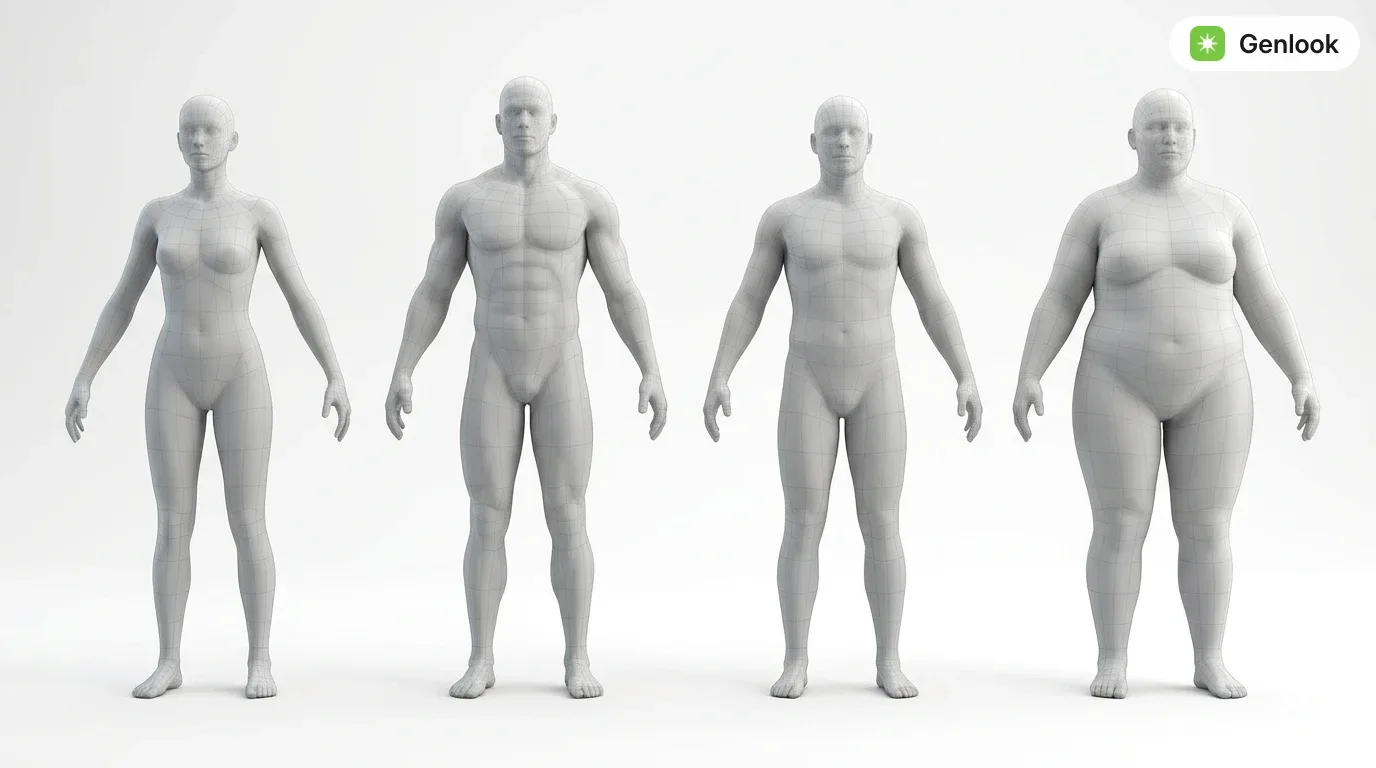
An adjustable digital mesh of the human body, generated from measurements or photos, used to simulate fit and sizing.
What is a 3D body model?
A 3D body model is a digital mesh representing the human body. Most are parametric: a small set of parameters (height, chest, waist, hip measurements, or learned shape coefficients) deforms a template mesh into a specific body shape. Research models such as SMPL popularized this approach, separating shape (the person's build) from pose (how they're standing).
The model can be created from manual measurements, a body scan, or estimated from one or more photos using pose estimation and shape regression.
What it's used for
- Size recommendation: comparing the body mesh against a garment's measurements to suggest a size.
- Fit visualization: showing where a garment would be tight or loose, often as a heatmap.
- Cloth simulation: physics engines drape digital garments over the mesh to preview drape in 3D garment design tools.
- Avatar try-on: dressing a personalized avatar rather than the shopper's own photo.
3D body models vs. photo-based try-on
Avatar approaches built on body models are strong on measurable fit but show an avatar, not the actual person. Photo-based virtual fitting rooms show the garment on the shopper's real photo, prioritizing visual realism over millimeter accuracy. Some systems combine both: a body model for sizing, generative imagery for the visual.
The main parametric models
| Model | Introduced | What it adds |
|---|---|---|
| SMPL | 2015, Max Planck Institute for Intelligent Systems | A compact body mesh driven by about 10 shape and 72 pose parameters; the reference model in research |
| SMPL-X | 2019 | Adds articulated hands and an expressive face to the body |
| STAR | 2020 | A sparser, more compact successor to SMPL with fewer parameters per vertex |
These models are learned from thousands of 3D body scans. Their shape parameters capture the main ways human bodies differ (overall size, height, weight distribution), so a handful of numbers can describe a very wide range of builds.
Where the body data comes from
- Measurements: height, weight and a few circumferences typed into a form. Fast, but self-reported numbers are often off by several centimeters.
- Smartphone scans: the shopper turns in front of the camera for a minute while software fits the mesh to the video. More accurate, but it asks for effort before the shopper sees anything.
- Single photos: shape regression from one image. The least effort, and the least precise on body proportions hidden by clothing.
- Dedicated scanners: booths and structured-light rigs used in labs and some retail stores. The most precise, and the least accessible.
Limits for online fashion
A body model is only as useful as the garment data next to it. Size recommendation needs each product's measurements, and cloth simulation needs a digital garment (a 3D pattern with fabric properties) for every SKU. That per-product digitization is the main reason avatar-based try-on is rare outside large retailers, and why most stores that add try-on today use photo-based generation instead. Body measurements are also personal data: a store collecting them should say how long they are kept and what they are used for.
FAQ
Questions, answered.
Can a 3D body model be created from a single photo?↓
Approximately, yes. Modern methods regress shape parameters from one image, though accuracy improves with multiple angles or known reference measurements. Scanning hardware remains the most precise option.
What is SMPL?↓
SMPL (Skinned Multi-Person Linear model) is a parametric 3D body model published in 2015 by researchers at the Max Planck Institute for Intelligent Systems. It represents a body with a small set of shape and pose parameters and is the most widely used body model in research, with extensions such as SMPL-X for hands and face.
Do you need a 3D body model for virtual try-on?↓
Not for photo-based try-on. Generative systems render the garment directly onto the shopper's photo without building a mesh. 3D body models are used when the goal is measurement-based sizing or physics-based cloth simulation.
The 30-second version
Related terms
- Drape
- The way a fabric hangs, folds, and flows when worn on a body.
- Pose Estimation
- Computer vision technology that detects the position of human body joints and landmarks in images or video.
- Virtual Fitting Room
- A digital experience that lets shoppers preview how clothing looks on them before buying online.