
 Shopify
 WooCommerce
 API
APIPose Estimation
Computer vision technology that detects the position of human body joints and landmarks in images or video.
What is pose estimation?
Pose estimation is a computer vision technique that identifies the position of human body joints (shoulders, elbows, wrists, hips, knees, ankles) in an image or video stream. The output is a set of keypoint coordinates, usually connected into a skeleton that describes the person's posture.
In try-on systems, pose estimation answers the question how is this body positioned? That answer determines where a garment lands, at what angle, and at what scale.
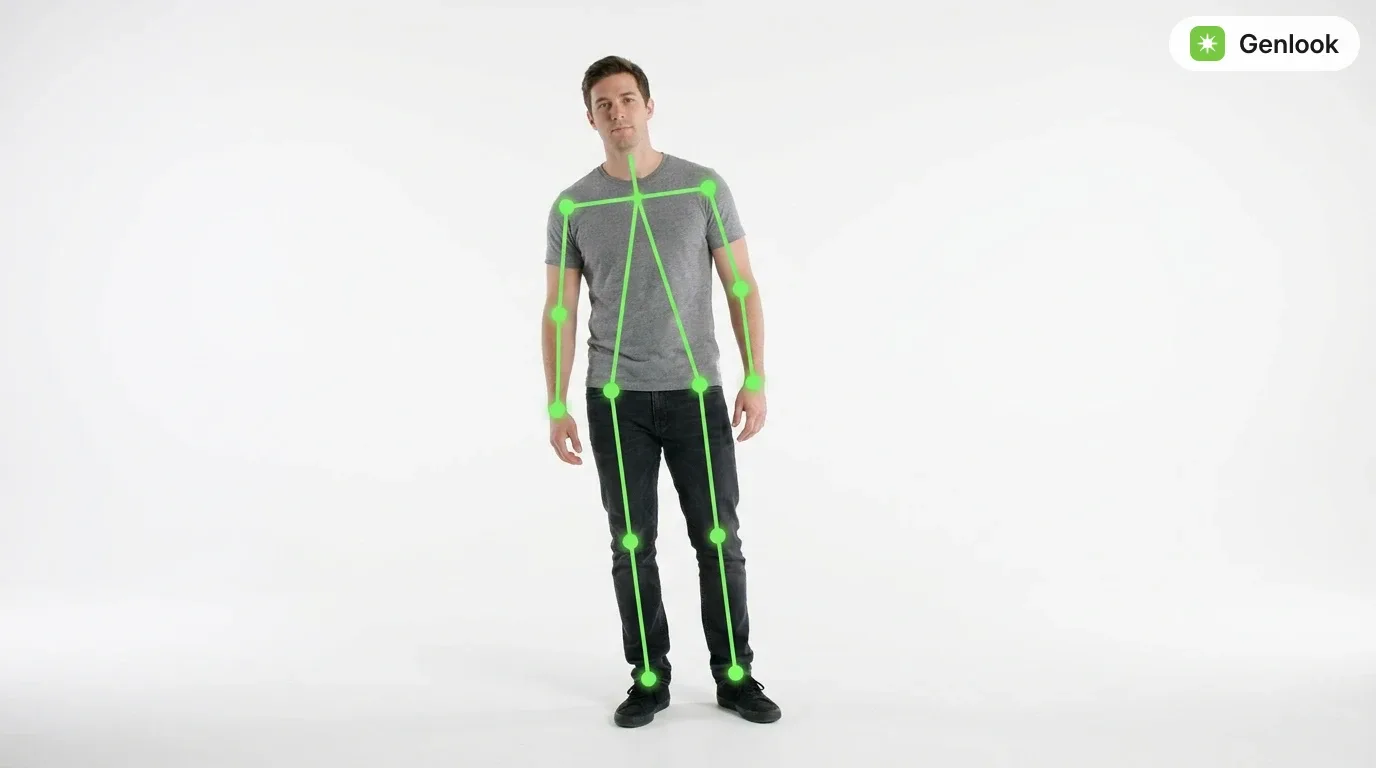
How it works
- Person detection: locate the human subject in the frame.
- Keypoint prediction: a neural network predicts the coordinates of 17–33 body joints.
- Skeleton assembly: keypoints are connected into a structure tracking posture and limb angles.
- Temporal smoothing (video only): predictions are smoothed across frames to reduce jitter.
Role in virtual try-on
- Image-based try-on: a single-photo pose estimate guides garment transfer, so sleeves follow the arms and the hem falls at the right height.
- Live AR try-on: per-frame pose estimation anchors 3D products (shoes, watches) to the moving body.
- Body measurement: joint positions help estimate proportions for 3D body models and size recommendation.
Inaccurate pose estimation produces misaligned results: a dress draped at the wrong angle or shoes offset from the feet.
FAQ
Questions, answered.
Is pose estimation the same as body scanning?↓
No. Pose estimation detects joint positions in 2D (or 2.5D) from ordinary images. Body scanning builds a full 3D mesh of the body surface, which requires specialized hardware or multi-angle capture.