 Shopify
 WooCommerce
 API
Virtual Fitting Room
A digital experience that lets shoppers preview how clothing looks on them before buying online.
What is a virtual fitting room?
A virtual fitting room is an online shopping feature that simulates the in-store fitting experience. Shoppers upload a photo or use a live camera feed, then see how a garment would look on them before adding it to cart.
Unlike a static size chart, a virtual fitting room focuses on visual confidence, helping customers judge style, drape, and overall appearance without physically trying the item on.
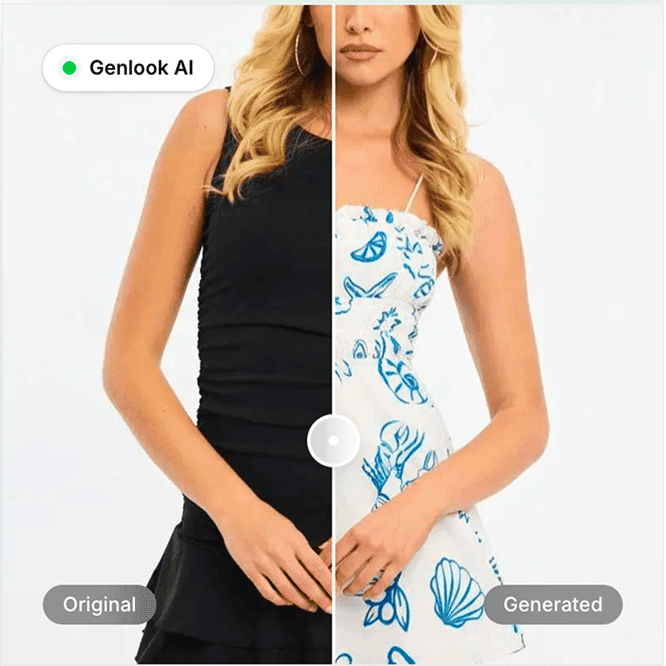
How virtual fitting rooms work
Most implementations follow a similar pipeline:
- Capture: the shopper provides a full-body or portrait photo, or activates a camera, usually via a try-on widget on the product page.
- Body mapping: image segmentation and pose estimation locate the person, their pose, and the clothes they are wearing.
- Garment rendering: the product is placed on the shopper via AR overlay for rigid items, or garment transfer for apparel.
- Result: a preview is shown, often with options to try other colors, sizes, or products.
Comparison of try-on methods
| Method | Input | Typical products | Per-product setup |
|---|---|---|---|
| Generative AI | Uploaded photo | Apparel, complex fabrics | None (uses existing photos) |
| AR try-on | Live camera | Eyewear, makeup, rigid accessories | 3D model per SKU |
| Avatar-based | Body measurements | Size guidance | Garment digitization |
| In-store smart mirror | Kiosk camera | Physical retail | Hardware + 3D assets |
What the data shows
In Genlook's State of Virtual Try-On report for Q3 2026, covering 890 stores and more than 282,000 AI try-ons, sessions with at least one try-on added to cart at 33.3%, against 11.3% for sessions without one. The report is clear that this is a correlation: shoppers who try something on are already more engaged. 92% of try-ons happened on a phone, which is why fitting rooms are designed mobile first.
A short history
Early virtual fitting rooms in the 2010s used webcam overlays that pasted a flat garment image over the shopper, and robotic mannequins (Fits.me, acquired by Rakuten in 2015) that reshaped to a shopper's measurements. Both needed per-product work and never spread far beyond large retailers. Generative AI changed the setup cost: a modern photo-based fitting room works from the product photos a store already has, so it can be installed on a small store in minutes.
What a fitting room can and cannot tell a shopper
A photo-based virtual fitting room answers a style question: how does this color, cut and print look on me? It does not measure the body, so it should not be presented as a size guarantee. Stores that need sizing help pair it with a size chart or a dedicated sizing tool.
FAQ
Questions, answered.
Is a virtual fitting room the same as virtual try-on?↓
The terms are often used interchangeably. Virtual try-on (VTO) is the broader technology category; a virtual fitting room is the shopper-facing experience built on top of it, typically embedded on a product page.
What do shoppers need to use one?↓
For photo-based fitting rooms, a clear front-facing photo taken with any smartphone. Camera-based (AR) fitting rooms require a device with a camera; avatar-based ones require body measurements.
Do virtual fitting rooms increase conversion?↓
Stores using them report higher add-to-cart rates among shoppers who try on. In Genlook's Q3 2026 data across 890 stores, sessions with a try-on added to cart at 33.3% versus 11.3% without. That gap mixes the effect of the tool with the fact that engaged shoppers are more likely to use it.