
 Shopify
 WooCommerce
 API
Can AI Finally Fix Fashion's Biggest Headache? The Future of Sizing
US online apparel returns run around 24%, and size and fit is the top reason. How data prediction, body scanning and generative virtual try-on each tackle a different part of the sizing problem.
Table of contents
It is the oldest joke in the fashion industry: A size 8 in one store is a size 12 in another.
But for e-commerce merchants, it’s not a joke. It’s a financial crisis.
The numbers are hard to ignore. The National Retail Federation and Happy Returns estimated that 19.3% of US online sales would be returned in 2025 (2025 Retail Returns Landscape). For online apparel the rate is higher: Coresight Research estimated 24.4% in 2023, from a survey of US apparel brands and retailers, and size and fit was the top return reason, named by 53% of respondents (The True Cost of Apparel Returns, sponsored by 3DLOOK).
For decades, the industry’s sole defense was the humble "Size Chart." While necessary, the size chart is often insufficient. It is a static 2D grid of numbers that demands customers have a tape measure handy and, more importantly, possess the spatial awareness to translate those numbers into a 3D reality.
As technology matures, Artificial Intelligence is moving beyond simple recommendation engines to tackle the complex geometry of the human body. Here is how AI is evolving to resolve the sizing crisis, and why the future isn't about replacing size charts, but supercharging them with Visual Validation.
The Problem: The Myth of Standard Sizing
Before understanding the cure, we must diagnose the disease. Why is sizing so fundamentally broken in the digital age?
1. The Proliferation of Vanity Sizing
Over the decades, many brands have made the measurements behind each label size larger, so customers fit into a smaller number. The US government's old commercial sizing standards were withdrawn long ago, so the same label can mean very different measurements from one brand, or one decade, to the next.
2. Lack of Global Standardization
There is no global governing body for sizing. A European fit, an American fit, and an Asian fit use entirely different grading templates. For a cross-border shopper, this makes the buying process a complete guessing game.
3. The "Fit Preference" Gap
This is where size charts fail most. Two customers might have the exact same 38-inch chest measurement. Technically, both fit into a Size Medium. However, one prefers a tight "muscle fit," while the other prefers a loose, oversized streetwear aesthetic. A static chart cannot capture preference; it only captures capacity.
The Evolution of AI Sizing Solutions
To solve this, the industry has gone through three distinct "waves" of technological innovation.
Wave 1: Data Prediction (The "Netflix" Model)
Solutions like True Fit built massive data consortiums (The Fashion Genome™). By analyzing purchase history (knowing you kept a Size 10 from Brand A but returned a Size 12 from Brand B), the AI predicts your likely size for a new brand.
- The Limitation: It relies on historical data. If you are shopping for a new body type (e.g., postpartum or fitness journey) or a brand with a unique avant-garde cut, the prediction fails. It tells you if it fits, but not how it looks.
Wave 2: Computer Vision & Body Scanning
This wave turns the smartphone into a tailor's tape. Tools like 3DLOOK ask shoppers for a front and a side photo and estimate body measurements from them (the company says 80+).
- The Limitation: Extra steps. Taking two posed photos is a separate task from shopping, and many shoppers browsing a lower-priced item won't stop to do it. The result is a measurement, not a picture of how the item looks.
Wave 3: Generative AI & Visual Validation (The Genlook Method)
The newest wave treats fit as two separate questions: Technical Fit (the numbers: will a medium fit?) and Visual Fit (the look: how does it look on me?).
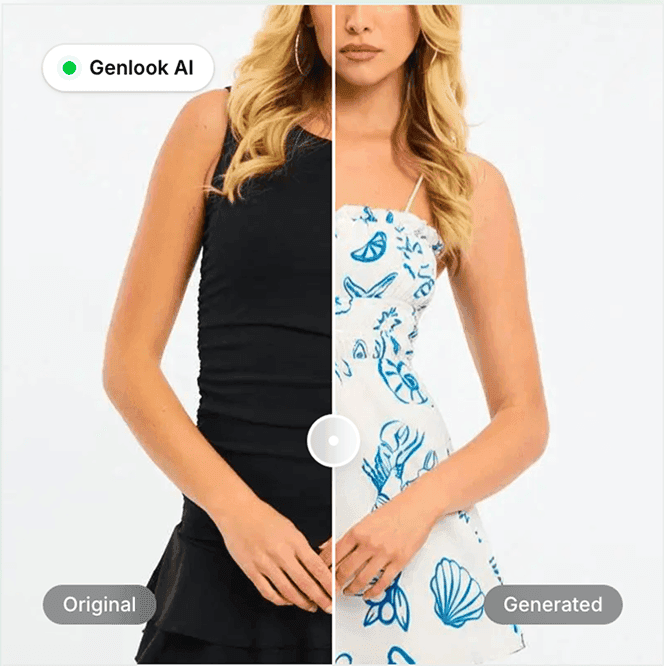
Genlook doesn't aim to destroy the size chart; it works alongside it to provide the missing visual context. By using Generative AI, Genlook allows customers to upload a single photo and instantly "see" themselves in the garment.
Why "Visual Fit" is the Missing Link
Visual try-on doesn't measure anyone, so it doesn't answer the size question on its own. What it adds is the part a chart can't show:
Drape and Fabric Physics
A size chart can tell you a shirt is made of 100% silk. It can't show you the overall look: a fluid silk shirt and a structured cotton one read very differently on the same person. Generative try-on renders the garment on the shopper's own photo from the product images, so the difference between a structured blazer and a soft knit is visible. It is a realistic preview, not a measurement of exact fit.
Less "Bracketing"
"Bracketing" is the practice of buying a size S, M and L, intending to return two of them. It is a margin-killer for merchants. Fit information can reduce it: in a randomized field experiment at an online clothing retailer, shoppers given a virtual fitting tool were less likely to order several sizes of the same item (Gallino and Moreno, 2018). That tool worked from shoppers' measurements, which is why the size answer and the visual preview work best together.
The Mirror Effect
Seeing an item on a model who looks nothing like you leaves doubt. Seeing it on your own photo makes the decision more concrete. The preview has to stay faithful to the product, though: research on AR try-on finds that previews which look better than the real item raise expectations and can backfire when the parcel arrives (Pape and Toporowski, 2025).
The Multi-Billion Dollar Impact: Beyond the Bottom Line
Solving the sizing issue isn't just about merchant profits; it's a global sustainability imperative.
Analysts expect fast growth: ResearchAndMarkets puts the virtual fitting room market at $6.6 billion in 2024, growing about 19% a year to 2030 (report summary). Part of the reason is that the cost of returns goes beyond margins:
- Logistics: every return is another shipment back through the supply chain.
- Waste: returned items that can't be inspected and resold economically may never go back on sale.
Whatever tools a store uses, every order that is right the first time avoids that extra shipment.
The Future: A Hybrid Reality
The size chart isn't going away. More and more, it will be the data source behind an answer, rather than a grid the shopper has to read.
The "better together" workflow:
- The size chart is the source of truth for measurements (build one in minutes with our free size chart generator).
- A size answer turns the chart into a recommendation for each shopper, like Genlook's AI size chart (currently on a waiting list).
- Virtual try-on shows the look, so the shopper can judge the style on their own photo.
Conclusion: The End of Guesswork
We may never see a world where every brand uses the exact same measurements. Brand DNA is often tied to a specific "cut" or "silhouette," and that variety is what makes fashion exciting.
What can change is how much guessing is left to the shopper. A clear size answer from the chart, plus a preview of the look on their own photo, covers the two questions shoppers ask before they buy.
Don't ask your customers to guess their size, or to imagine the look.
Equip your store with the sizing duo: get started with Genlook today.
FAQ
Questions, answered.
Why are traditional size charts ineffective on their own?↓
Size charts provide raw numbers, but they ignore 'Vanity Sizing' and style preferences. Most customers struggle to translate a 2D measurement (like chest width) into a 3D reality (how it will actually drape on their body).
Does Genlook replace my size chart?↓
No, it enhances it. Size charts answer 'Will I fit in this?' while Genlook answers 'Will I look good in this?'. The best results come from using both: the chart for technical specs and Genlook for visual confirmation.
Does AI sizing reduce returns?↓
The best evidence concerns fit information: a randomized field experiment at an online clothing retailer found that a virtual fitting tool reduced returns and multi-size orders (Gallino and Moreno, 2018). Independent evidence on generative photo try-on and return rates is still limited, so measure it in your own store with a holdout test. We summarized the research in Does virtual try-on reduce returns?
Does Genlook measure the customer?↓
No. Genlook's virtual try-on shows how the garment looks on the shopper's own photo. It doesn't take measurements, so sizing still comes from your size chart, which Genlook's AI size chart (on a waiting list) is built to turn into a size answer for each shopper.