
 Shopify
 WooCommerce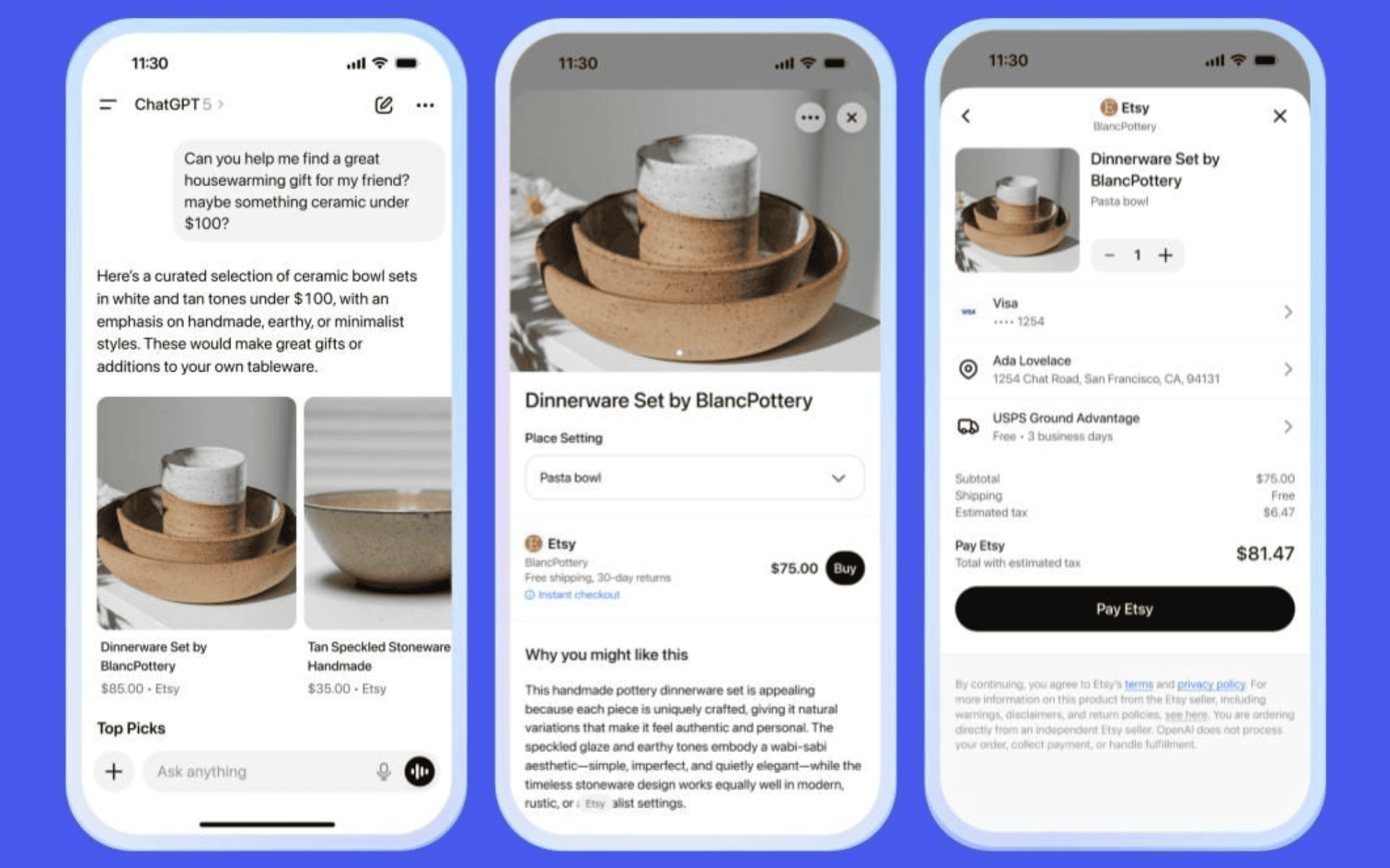
The paradigm of e-commerce discovery has officially shifted. Customers are no longer scrolling through endless grids of products on traditional storefronts; instead, they are simply asking AI.
As of early 2026, ChatGPT processes over 50 million shopping queries daily from its 700 million users, representing a staggering 4,700% growth in AI shopping queries since 2024.
For fashion merchants on Shopify, the writing is on the wall: the future of retail is Agentic Commerce. With the recent launch of Shopify's ChatGPT integration and Instant Checkout, AI is no longer just a research assistant; it is the checkout counter.
Here is everything you need to know about the Shopify x ChatGPT integration, and a practical guide to preparing your fashion store to dominate AI product discovery.
What Is ChatGPT Shopping and Instant Checkout?
In late 2025 and early 2026, OpenAI, in partnership with Stripe, launched the Agentic Commerce Protocol (ACP). This open-source standard allows AI agents to securely facilitate purchases directly within a chat interface.
For the consumer, the experience is magical. They ask ChatGPT, "Find me a sustainable red dress for a beach wedding under $200." ChatGPT searches merchant feeds, presents the best options, and provides a "Buy Now" button right in the chat. The user completes the purchase without ever visiting the merchant's actual website.
Over 1 million Shopify merchants are now eligible for this feature, joining major early adopters like Glossier, SKIMS, and Spanx.
How the Technical Flow Works Behind the Scenes
While the user experience feels like buying directly from OpenAI, you remain fully in control as the merchant.
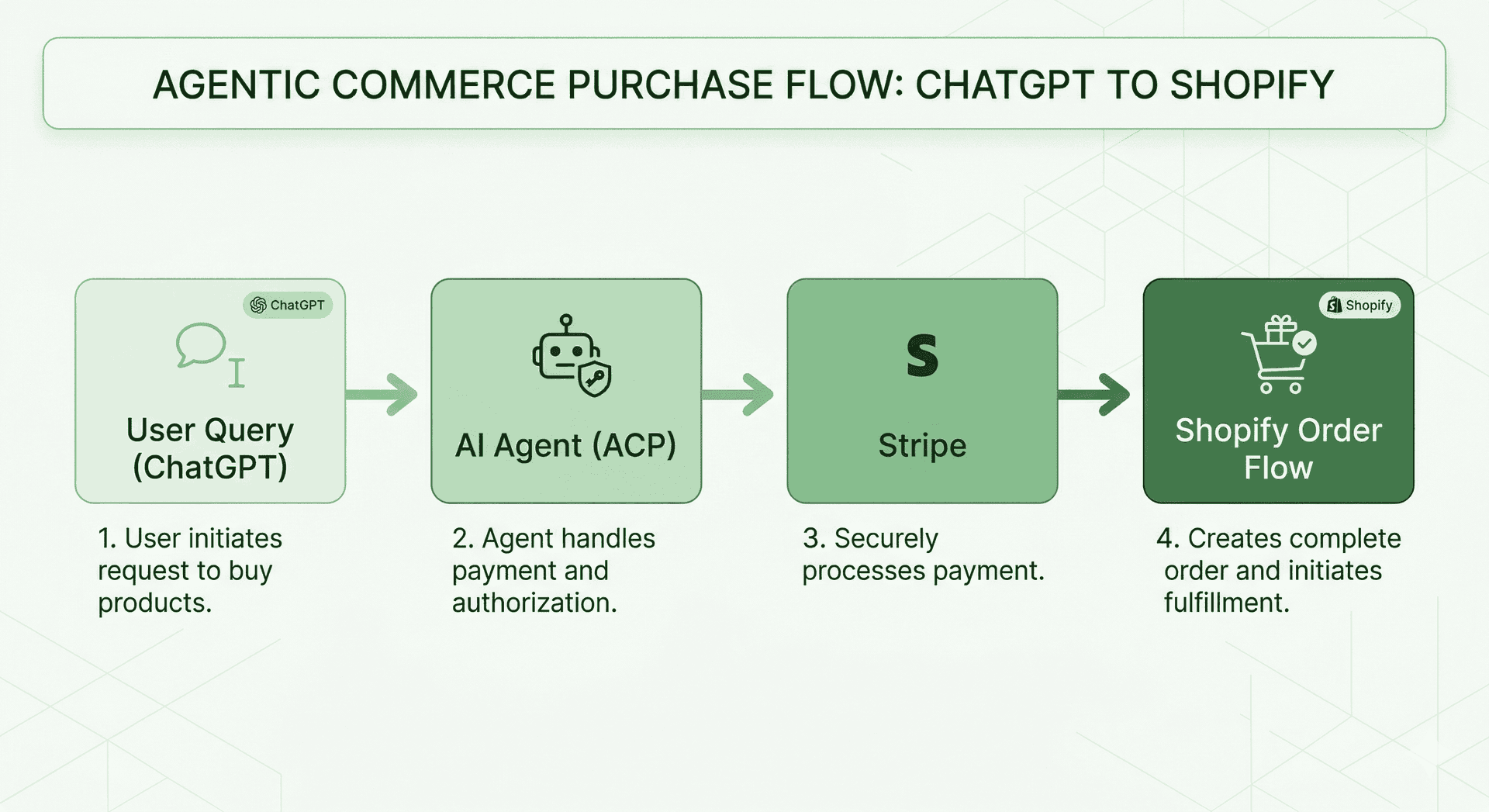
- Discovery: ChatGPT reads your optimized product feed.
- Recommendation: It presents your product to the user in the chat interface.
- Checkout: The user clicks "Buy". The Agentic Commerce Protocol uses a Shared Payment Token (SPT) via Stripe to securely pass payment data.
- Fulfillment: Your Shopify backend receives the order, calculates shipping and taxes, and accepts the payment. You fulfill the order exactly as you normally would.
For fashion retailers, this frictionless checkout presents a unique challenge: how do you build buyer confidence when the customer never sees your carefully designed product page? This is where visual confidence tools like Genlook's Virtual Try-On become critical, ensuring that the product ChatGPT recommends actually fits the user, preventing post-purchase regret.
ChatGPT is not alone in this race: Google's Universal Cart is bringing the same agentic checkout model to Search, Gemini, YouTube, and Gmail.
What Does ChatGPT Instant Checkout Cost?
Since January 26, 2026, OpenAI charges Shopify merchants a 4% fee on orders completed through ChatGPT Instant Checkout. The figure was confirmed by Shopify and reported by The Information, and OpenAI's official Instant Checkout documentation describes it as a fee on completed purchases that does not affect shopper prices or influence ChatGPT's product results.
Here is how the fee works in practice:
- 4% per completed order, charged on top of your standard Shopify payment processing fees. It is deducted automatically before your payout, so there is no separate invoice from OpenAI.
- 30-day free trial: the fee only kicks in 30 days after your first qualifying Instant Checkout order.
- It only applies to in-chat purchases. If a shopper discovers your product in ChatGPT but clicks through and completes the purchase on your own store checkout, Shopify's documentation confirms there is no additional fee beyond standard payment processing.
- Discovery stays free. Being listed and recommended in ChatGPT costs nothing; you only pay when an Instant Checkout sale actually closes.
For comparison, sales completed through Google AI Mode, Gemini, and Microsoft Copilot direct checkouts currently carry no additional platform fee. For fashion merchants working on tight margins, the 4% is worth modeling into your unit economics, but keep perspective: it is comparable to a marketplace referral fee and far below the 15% to 45% commissions common on traditional marketplaces.
The 2026 Shift: Dedicated Merchant Apps vs. Open Discovery
While direct Instant Checkout inside ChatGPT is revolutionary, OpenAI is also shifting strategy in 2026 to support merchant-branded ChatGPT apps.
Major retailers like Target and DoorDash are launching their own dedicated AI apps within the OpenAI ecosystem. For smaller and mid-sized Shopify merchants, this means that optimizing your raw product feed for the general ChatGPT interface is your primary battleground for visibility against these massive retail giants.
Step-by-Step: Enabling ChatGPT Shopping on Shopify
Getting your store technically ready for ChatGPT is surprisingly simple. Because Shopify has natively integrated with OpenAI, you do not need a developer to wire up custom APIs. You can generally manage this right from the Shopify Admin.
- Enable the Channel: Go to your Shopify Admin and install the ChatGPT sales channel from the Shopify App Store.
- Opt-In: Explicitly opt-in to the Instant Checkout feature. (See Shopify's official documentation on managing Sales Channels for step-by-step guidance).
- Payments: Ensure your Stripe payment integration is active and properly configured for delegated payments under the Agentic Commerce Protocol.
- Register: Sign up at chatgpt.com/merchants to join the OpenAI merchant program and ensure your product feed is set to real-time or daily sync.
The Real Work: Optimizing Your Product Feed for AI Discovery
Technical setup is only step one. ChatGPT does not read your beautiful website layout; it reads your raw product data feed. If your data is messy, AI agents will ignore you. Data shows that stores with 99.9% attribute completion see 3-4x higher AI visibility.
To optimize your feed:
- Conversational Titles: Replace SKU-style naming conventions. Instead of
"W-Dress-Red-01", use"Women's Sustainable Red Maxi Dress, Summer Beach Wedding, Lightweight". - Complete All Attributes: Fill in GTINs, colors, sizes, materials, and target demographics for every single variant. Do not leave fields blank.
- Rich Metafields: Add structured data for care instructions, shipping times, and return windows.
- Enriched Descriptions: Write descriptions that focus on use cases and problems solved. AI models reason over text, so telling the AI that a dress is "perfect for hot summer destination weddings" helps it match the product to specific user prompts.
The Genlook Advantage: When you use Genlook's Virtual Try-On, you enrich your product experience. While the AI agent handles the discovery, the robust, interactive try-on experience signals high engagement and low return probability, which are critical metrics for recommendation algorithms.
GEO: Why Generative Engine Optimization is the New SEO
Traditional Google SEO relied on backlinks and keyword stuffing. In 2026, merchants must master GEO (Generative Engine Optimization).
To win in GEO, you need:
- Schema Markup: Flawless
Schema.org/Productmarkup on your site. - AI-Citable Content: Clear, concise 80-120 word summaries of your products, specs, and availability that AI crawlers can easily digest and quote.
- Real-Time Accuracy: Outdated pricing or inventory data severely damages your "trust score" with AI agents.
Brands implementing strict GEO practices are currently seeing a 3.2x increase in AI impressions compared to those relying solely on traditional SEO.
Beyond the Feed: Sending Visual Trust Signals to AI Agents
AI agents are designed to recommend products that provide good user experiences. But how does an AI know if a product is "good"? It looks at trust signals: reviews, rich media, conversion rates, and return rates.
If you want an AI agent to recommend your fashion brand over a competitor, you need to prove that your customers are highly satisfied and rarely return items. Virtual Try-On is the ultimate trust signal.
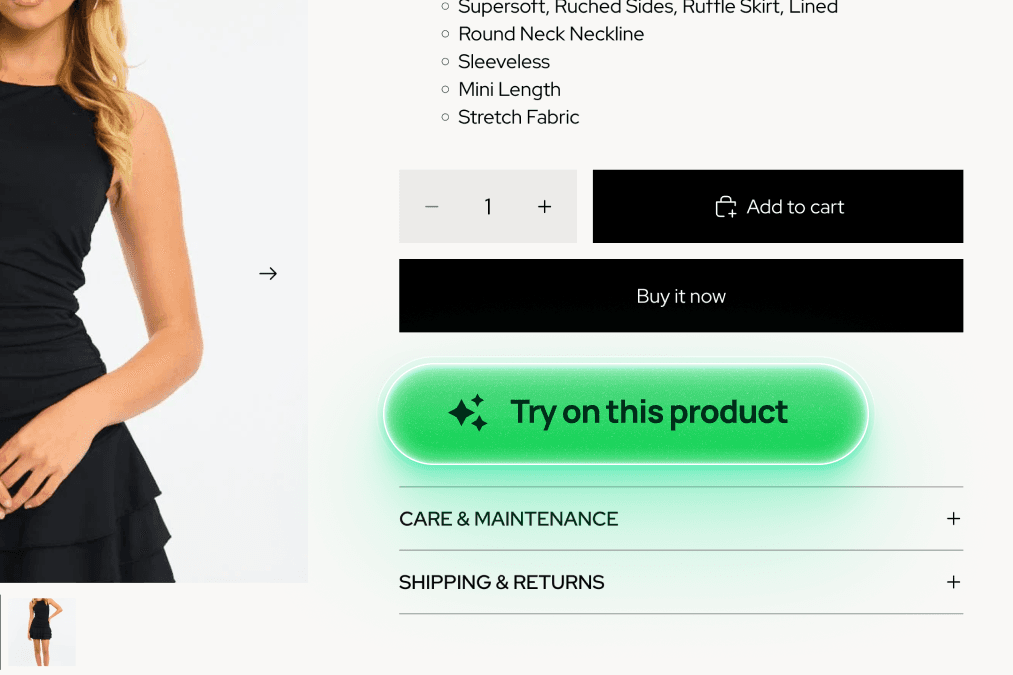
Shoppers who use high-quality Virtual Try-On tools convert at up to a 35% higher rate and return items 15% to 35% less frequently. Furthermore, Genlook allows you to capture zero-party data (like emails and morphological preferences) through the try-on experience, allowing you to build robust marketing lists independent of AI platforms.
These metrics (high conversion and low returns) are the exact signals that AI shopping agents use to decide which products are reliable enough to recommend to their users.
Ready for the Agentic Future?
The shift to Agentic Commerce is inevitable. The days of relying entirely on traditional search and social scrolling are ending. Your new competitive moat is the quality of your product data combined with the trustworthiness of your shopping experience.
Fashion merchants who combine flawlessly optimized product feeds with Genlook's Virtual Try-On are building the exact trust profile that AI agents reward.
Don't just get listed in ChatGPT. Get recommended.
Get started with Genlook today to reduce returns, boost conversions, and future-proof your e-commerce store.
FAQ
Questions, answered.
How do I enable ChatGPT Shopping on my Shopify store?↓
You can enable the ChatGPT sales channel directly in your Shopify Admin. You must opt-in to Instant Checkout and have a Stripe payment integration configured. Shopify handles the catalog data feed to OpenAI automatically.
How much does ChatGPT Instant Checkout cost for Shopify merchants?↓
Since January 26, 2026, OpenAI charges a 4% fee on each order completed through Instant Checkout, on top of your standard Shopify payment processing fees. It is deducted automatically before payout, and a 30-day free trial starts after your first qualifying order. Listing and discovery in ChatGPT remain free, and the fee does not influence ChatGPT's product recommendations.
Does the 4% fee apply if the customer checks out on my own store?↓
No. The fee only applies to purchases completed inside ChatGPT via Instant Checkout. If a shopper finds your product in ChatGPT and clicks through to complete the purchase on your store's checkout, you pay only your standard payment processing fees, per Shopify's official documentation.
What is the Agentic Commerce Protocol (ACP)?↓
ACP is an open standard developed by OpenAI and Stripe that securely transmits payment information and order data between AI agents (like ChatGPT) and merchant backends, allowing you to remain the merchant of record.
How does Virtual Try-On help my store rank in ChatGPT?↓
AI agents recommend products they 'trust'. By using tools like Genlook to offer Virtual Try-On, you drastically reduce your return rates and boost conversion rates, metrics that signal high customer satisfaction and reliability to AI recommendation algorithms.