
 Shopify
 WooCommerce
 API
APIReturn Rate
The percentage of sold items (or revenue) that customers send back, a core profitability metric in fashion e-commerce.
What is return rate?
Return rate is the percentage of sold items (or revenue) that customers send back:
return rate = returned items / items sold × 100
It can be measured in units or in value, gross (all returns) or net of fraud, per product, per category, or store-wide. In fashion e-commerce it is one of the few metrics that directly moves profitability in both directions: every avoided return saves the margin twice.
Average return rates
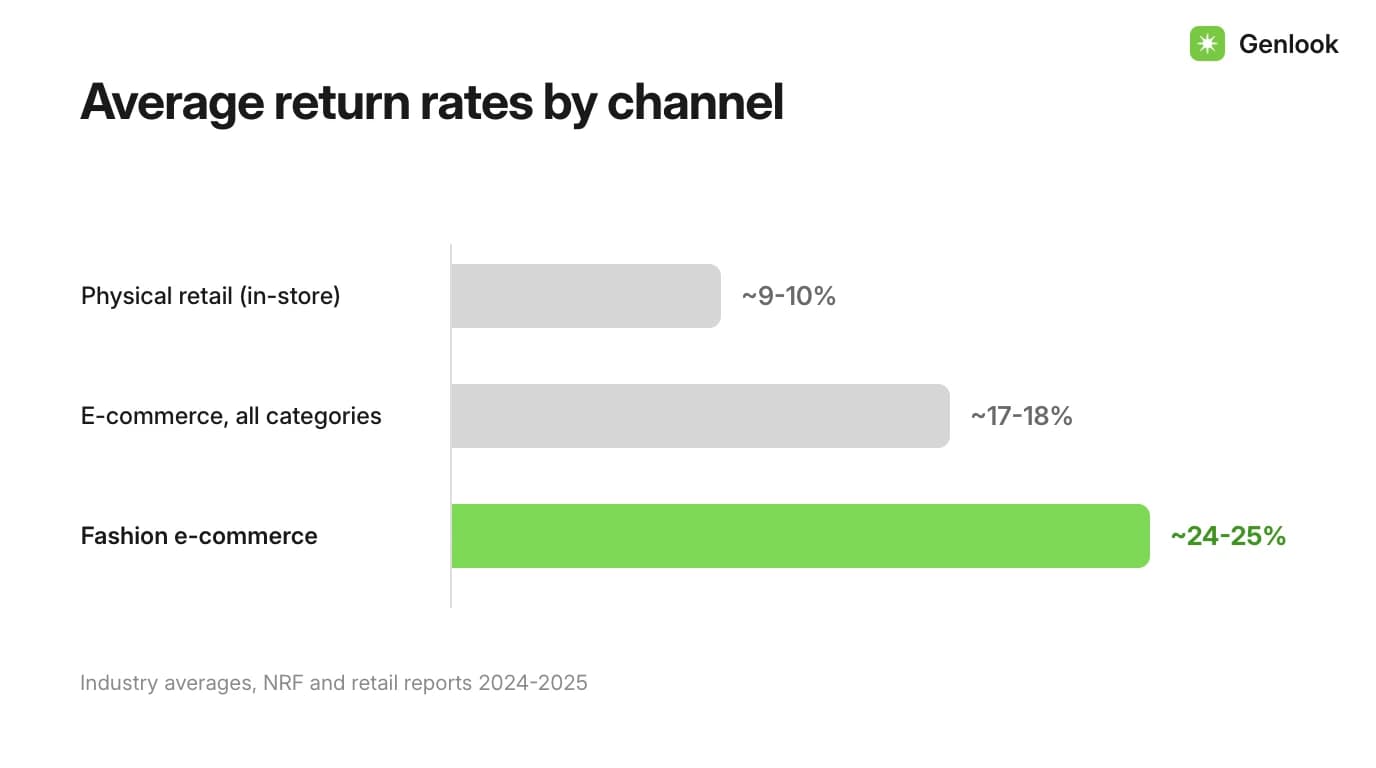
Typical industry averages (NRF and retail industry reports, 2024-2025):
| Channel / category | Typical return rate |
|---|---|
| Physical retail (in-store) | ~9-10% |
| E-commerce, all categories | ~17-18% |
| Fashion / apparel e-commerce | ~24-25% |
| Footwear e-commerce | ~20-25% |
| Occasion wear, premium denim | 30%+ |
Two more numbers frame the problem: processing a single return typically costs 45-66% of the item's price (shipping both ways, inspection, restocking, liquidation), and the majority of fashion returns are preference-based: poor fit, style mismatch, or the item looking different in person than on screen.
What drives fashion returns
- Fit uncertainty: sizing varies across brands, so shoppers guess, or bracket several sizes.
- Expectation gap: the product photo (one model, one body type, studio lighting) doesn't show how the item looks on the buyer.
- Policy incentives: free, frictionless returns make ordering-to-try rational behavior.
Countermeasures map to the causes: garment-specific size charts and fit data for the numeric half, virtual try-on for the visual half, and return policies that reward keeping (exchanges, store credit) over refunding.
FAQ
Questions, answered.
What is a good return rate for a fashion e-commerce store?↓
Below ~20% is better than average for online apparel; below 15% is strong. The right target depends on category: basics return far less than occasion wear or fitted denim.
Why are online return rates so much higher than in-store?↓
In a store, the fitting room filters out bad purchases before they happen. Online, that filtering happens after purchase, at the merchant's expense, unless fit and visualization tools move it back before checkout.