
 Shopify
 WooCommerce
 API
APIAugmented Reality (AR)
Technology that superimposes digital content (3D models, images, information) onto a live view of the real world.
What is augmented reality?
Augmented reality (AR) is a technology that overlays digital content such as 3D models, images, or information onto a live view of the physical world, usually through a phone camera or headset. Unlike virtual reality (VR), which replaces the environment entirely, AR adds to the user's real surroundings.

Types of AR in e-commerce
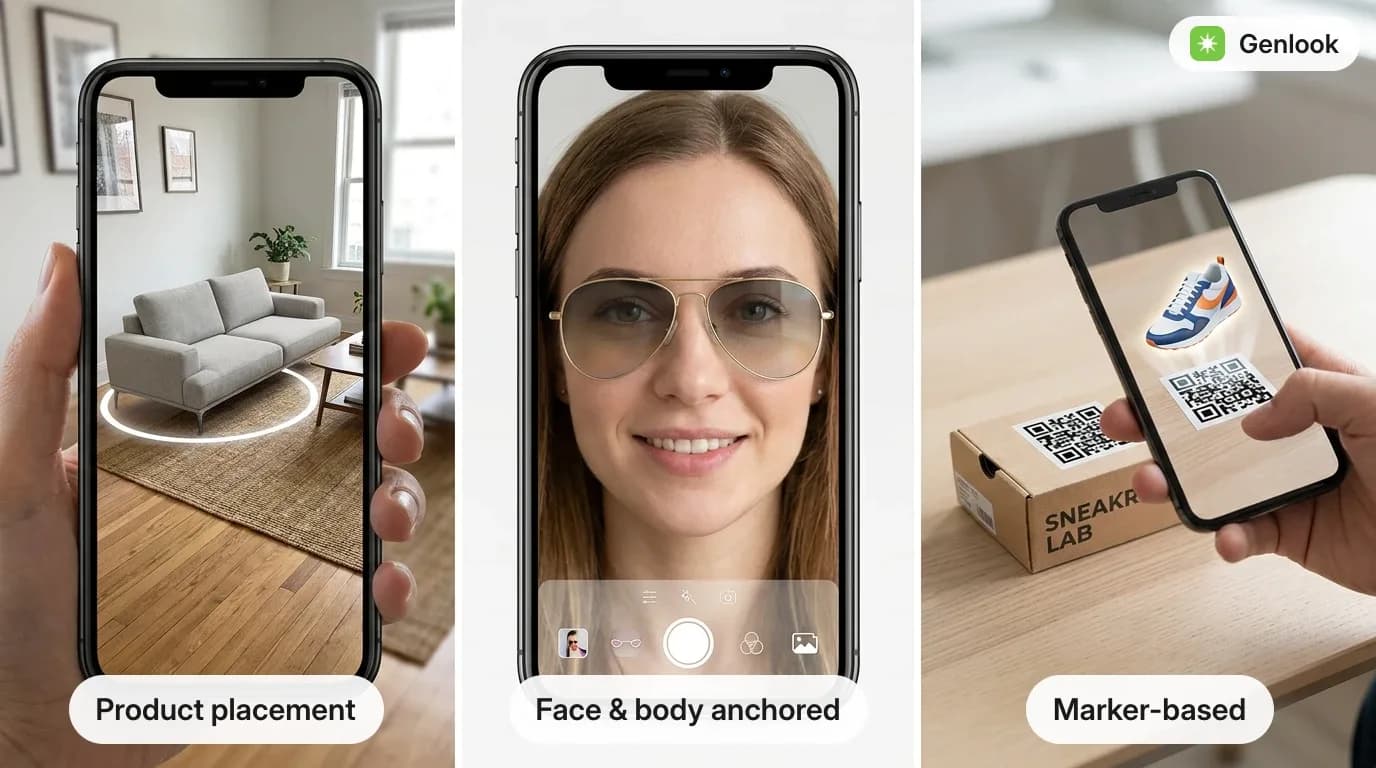
- Product placement: visualizing items at scale in the user's space (furniture in a living room).
- Face and body anchored AR: AR try-on of glasses, makeup, watches, or shoes, anchored via face tracking or pose estimation.
- Marker-based AR: digital content triggered by scanning a code or printed marker, used in packaging and campaigns.
Delivery has shifted from dedicated apps toward browser-based AR (WebAR), which runs directly on a product page without a download.
AR vs. generative AI in shopping experiences
AR renders pre-built 3D models live; generative AI synthesizes new imagery from photos. In practice e-commerce uses both: AR for rigid products in real time, and generative approaches in virtual fitting rooms for apparel, where fabric behavior can't be convincingly rendered from a fixed 3D asset.
FAQ
Questions, answered.
What's the difference between AR and VR?↓
VR replaces your environment with a fully digital one, requiring a headset. AR keeps the real world visible and adds digital elements to it, which is why it works on an ordinary smartphone.