 Shopify
 WooCommerce
 API
APIOcclusion
Hiding the right parts of a virtual object behind real-world elements that are closer to the viewer.
What is occlusion?
Occlusion is when an object closer to the viewer hides part of an object behind it. In virtual try-on and augmented reality, occlusion handling means rendering virtual products with the correct depth ordering relative to the real scene: a hand in front of a shirt must stay in front of the virtual shirt too.
When occlusion fails, the virtual item appears painted on top of everything: a ring covering the finger that should hide its back, or a generated jacket overwriting the hair that falls over it. It is one of the most immediate giveaways that an image is fake.
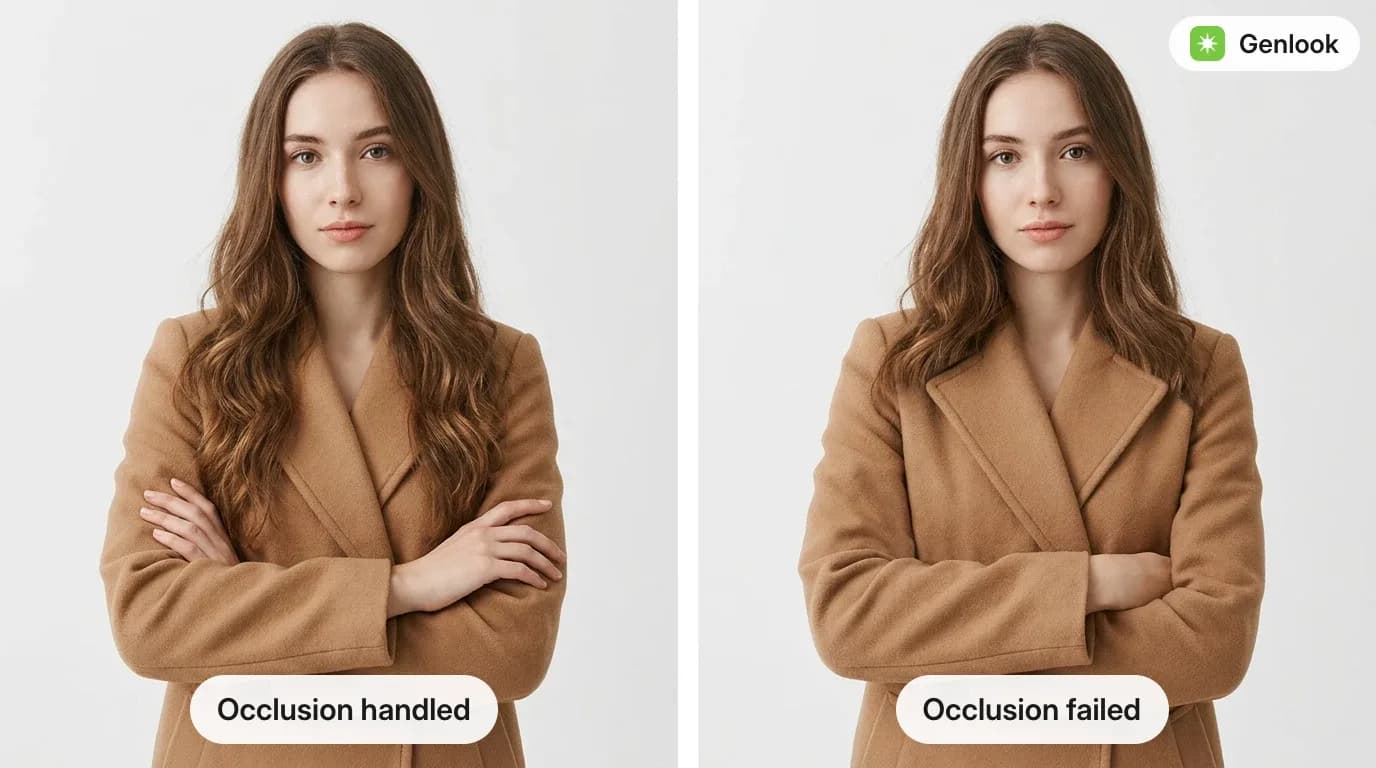
Common occluders in try-on
- Hair falling over shoulders and collars
- Hands and arms crossed in front of the torso
- Accessories such as bags, scarves, or jewelry worn over clothing
- Other garments, like an open jacket partially covering the top underneath
How it's handled
In live AR, depth ordering comes from real-time hand and body tracking plus depth estimation of the scene. In image-based pipelines, image segmentation identifies occluding elements so that inpainting regenerates the garment behind them. The occluders are excluded from the mask and preserved from the original photo.
FAQ
Questions, answered.
Why is occlusion harder for apparel than for rigid products?↓
Rigid items like glasses have predictable occluders (ears, nose) at known positions. Clothing covers large, deformable regions where hair, hands, and layered garments can overlap anywhere, so the occlusion mask must be computed per image.